Food Crops Background
The Policy Brief, Spring 2026: What’s Moving in School Food Policy
This spring, school food policy moved on many fronts. Here’s what shaped the season.
NEW Food Education in the Classroom Microcredential for K-5 educators! Next session: Nov. 2 – Dec. 13.
This spring, school food policy moved on many fronts. Here’s what shaped the season.
On April 30, the House passed its version of the Farm, Food, and National Security Act of 2026, also known as the Farm Bill, a major food and agriculture package that also affects nutrition programs. The bill is now in the Senate, which is expected to introduce its version in the coming weeks.
For schools, one of the biggest concerns is what the bill does not do: it does not restore SNAP cuts enacted through H.R. 1. When families lose SNAP, fewer students may be automatically certified for free school meals through direct certification. Schools may also face more paperwork and greater challenges in keeping the Community Eligibility Provision (CEP) financially viable.
🚨 Take action now 🚨: Urge your senators to protect SNAP, direct certification, CEP, and the school meal programs students rely on.
USDA announced a major reorganization of the federal offices that administer nutrition programs. Under the plan, the Food and Nutrition Service would become a new Food and Nutrition Administration, with SNAP relocating to Indianapolis, Child Nutrition Programs to Dallas, Supplemental Nutrition and Safety Programs to Kansas City, research programs to Raleigh, and emergency management and continuity operations to Denver. USDA says the change is intended to improve service and oversight and will not disrupt program operations.
Anti-hunger and nutrition advocates have raised concerns. FRAC strongly opposed the plan, warning that moving program leadership and staff out of Washington, DC, combined with staffing cuts and funding freezes, could weaken USDA’s ability to administer federal nutrition programs effectively and on time. The National WIC Association also warned that the reorganization could disrupt WIC operations by weakening regional support, state and local coordination, and timely technical assistance. For schools and state agencies, clear guidance, consistent technical assistance, and strong federal-state coordination are essential to programs like school meals, SNAP, WIC, summer meals, and CEP.
Separately, 20 states and the District of Columbia sued USDA over new federal funding conditions that they argue could threaten essential nutrition and agriculture programs. States say more than $74 billion annually in USDA funding could be affected, including SNAP, school lunch, and WIC. The plaintiff states also said they could collectively lose at least $11.6 billion in Child Nutrition Program funds, affecting programs such as the National School Lunch Program, School Breakfast Program, Child and Adult Care Food Program, Summer Food Service Program, Summer EBT, Fresh Fruit and Vegetable Program, and Special Milk Program.
The Universal School Meals Program Act of 2026 was reintroduced by Senator Bernie Sanders (I-VT) and Representative Ilhan Omar (D-MN). The bill would provide free breakfast, lunch, dinner, and a snack to every student nationwide, regardless of income. The bill would also eliminate school meal debt, increase school reimbursement rates, support local food purchasing, expand access to summer meals, and increase SUN Bucks/Summer EBT for children eligible for free and reduced-price school meals.
The Feed Our Kids Act of 2026 was introduced by Representative Josh Gottheimer (D-NJ) and co-sponsored by Representatives Darren Soto (D-FL) and Brittany Pettersen (D-CO). This bill would also provide free breakfast, lunch, and afterschool snacks to students in K–12 public schools.
In Colorado, lawmakers moved to sustain the state’s Healthy School Meals for All program, which provides free breakfast and lunch to students in participating public schools. Colorado’s program has faced funding pressure because of strong participation and rising costs, making this year’s funding action especially important. H.B. 26-1153 increases school meal reimbursements by more than $35 million.
In Connecticut, the newly approved state budget includes $12 million for universal free school breakfast, making breakfast available to every student at no cost. While the investment does not extend to lunch, it represents another example of states moving to reduce barriers to school meals and help families manage rising costs.
In Illinois, lawmakers and advocates continued pushing for state investment, including S.B. 1419, which would appropriate $67 million to support the state’s Healthy School Meals for All program. The state passed Healthy School Meals for All in 2023, creating a pathway to free breakfast and lunch for students statewide, but the program has not yet received the funding needed for full implementation. The effort is a reminder that sustained funding is essential to ensuring that a Healthy School Meals for All policy can continue to be implemented.
In Kentucky, lawmakers passed a local procurement measure that could make it easier for schools to serve Kentucky-grown foods. S.B. 5 allows districts participating in USDA Child Nutrition Programs to purchase state-grown agricultural products with greater flexibility.
In Maine, lawmakers expanded the state’s universal school meals program to reach more young children. Maine already provides free school meals to public K–12 students, but some public pre-K students were left out because their classrooms were located in community-based childcare settings rather than on school grounds. The state’s supplemental budget includes ongoing funding for a new grant program to help cover breakfast, lunch, and snacks for those children, closing a gap in access for some of the state’s youngest learners.
In Massachusetts, two essential amendments to the Department of Elementary and Secondary Education budget were advanced by state representatives to sustain the competitive MA FRESH grant program with $750,000 for the next school year (Amendment #308) and provide $2 million to restart the Local Food for Schools Program (Amendment #309). These legislative actions, if passed in final chamber reconciliations, help ensure school districts have the essential resources to improve food literacy, upgrade kitchen infrastructure, and maintain healthy, locally sourced meal programs across the Commonwealth.
In Nebraska, lawmakers created a pilot program, in effect from the 2026–27 school year through the 2031–32 school year, to help more students access free school meals. The new Hunger-Free Schools Program focuses on students who qualify for reduced-price meals, providing access to breakfast and lunch at no cost for those students.
In North Dakota, voters will decide this November whether to guarantee free breakfast and lunch for public school students statewide. The measure reached the ballot after a similar proposal passed the state House but failed narrowly in the Senate, sending the issue to voters instead. The citizen-led Together for School Meals coalition submitted more than 57,000 signatures—far more than required—to place the measure on the ballot. If approved, Measure 3 would make North Dakota one of the next states to advance universal school meals, showing how advocates can continue building momentum even when legislation stalls.
In Washington, state and local leaders are moving on school meal access in different ways. Washington passed H.B. 2594, which requires school meals for students experiencing homelessness and directs the state to develop an implementation plan. Meanwhile, Seattle is considering a six-year education and family affordability plan that would provide free school meals to every student in every Seattle public school starting this fall. The proposal frames school meals as part of what students need to be ready to learn, alongside investments in preschool, youth mental health, mentoring, tutoring, and college and career pathways.
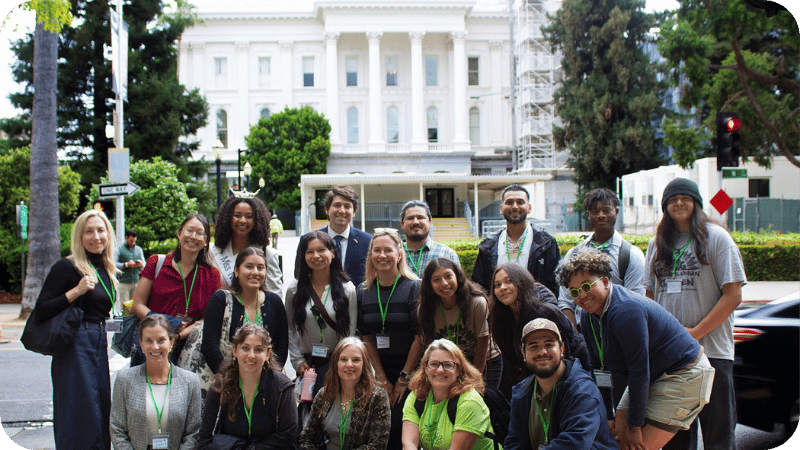
In April, FoodCorps joined the California School Garden Coalition in Sacramento to advocate for policies that make garden-based learning accessible to more students. FoodCorps staff, corps members, and alums met with over 40 legislative offices in support of a $25 million budget request for K–12 garden-based education through CDFA’s Farm to School Program, along with a policy update to better align California’s school garden work with the Office of Farm to Fork.
FoodCorps advocates also took action online, sending more than 100 emails to legislators in support of the school garden budget request.
FoodCorps staff also joined close to 1,000 advocates from across the country at FRAC’s Anti-Hunger Policy Conference and Advocacy Day in Washington, DC. Alongside partners from their home states, FoodCorps staff met with congressional offices to urge lawmakers to protect and strengthen child nutrition programs, including SNAP, direct certification, CEP, and school meals.
Creating an advocacy profile helps FoodCorps share advocacy opportunities that are relevant to where you live, from federal action alerts to state and local campaigns. Create your advocacy profile and explore your state’s school food policy.

From the Archive: Snow Days, Hungry Days (2019)

Policy Spotlight: 15 Years That Shaped School Meals
Lunch Today, Leaders Tomorrow: 15 Years of FoodCorps