Food Crops Background
From the Archive: Snow Days, Hungry Days (2019)
A 2019 story from Michigan about when hunger hits hardest.
NEW Food Education in the Classroom Microcredential for K-5 educators! Next session: Nov. 2 – Dec. 13.
A 2019 story from Michigan about when hunger hits hardest.
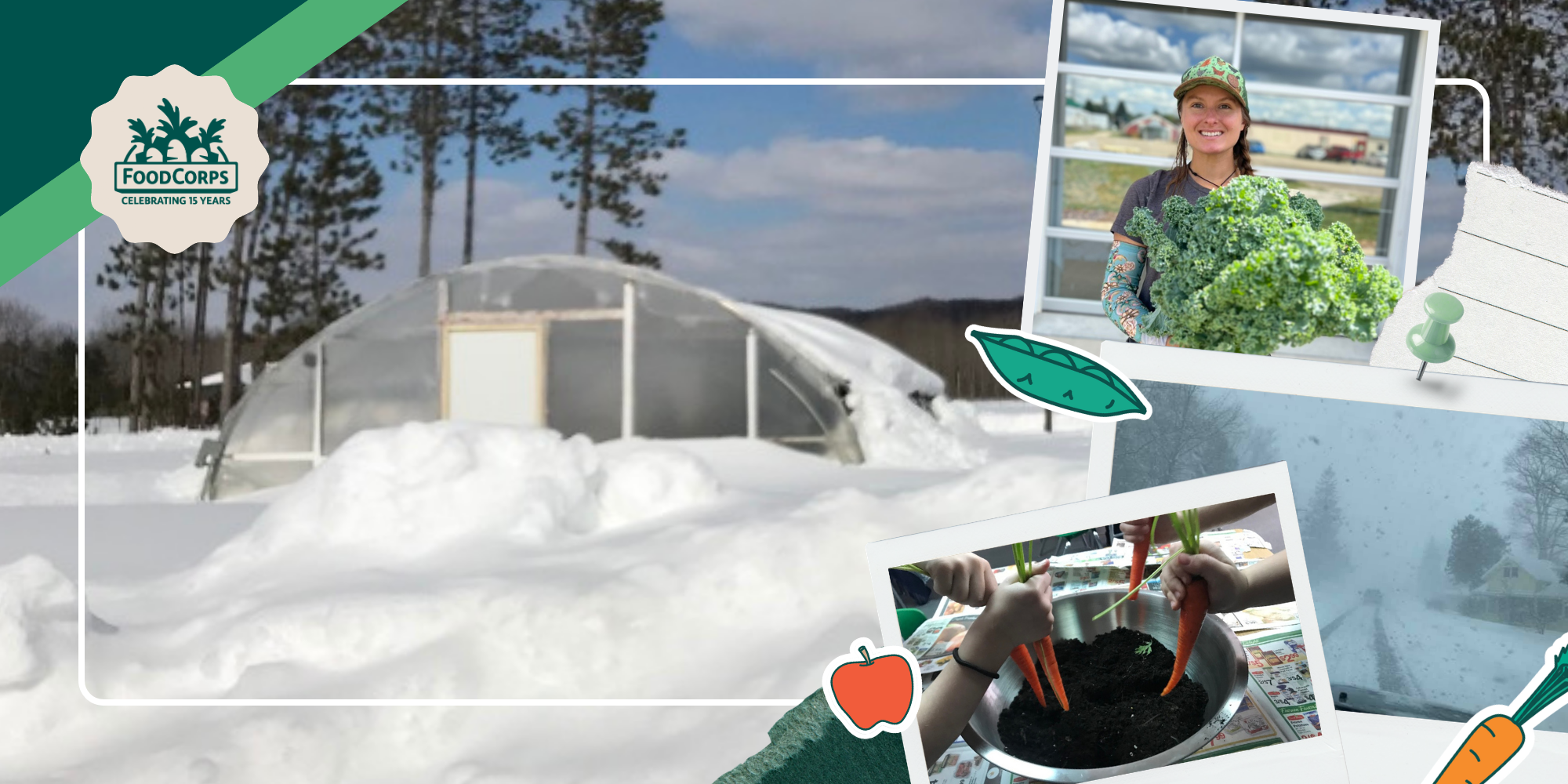
As we celebrate 15 years of FoodCorps, we’re peering into the archives for stories that showcase our work over the years.
This essay by Casey Haggerty (MI ’19, ’20) was selected as the winner of the 2019 Victory Growers Award for its compelling account of hunger in her community. We’re revisiting it today because nourishing school meals are as crucial as ever to kids’ well-being.
What’s Casey up to after FoodCorps? She’s Casey Young now, for one! After FoodCorps, Casey spent a year working alongside her host site, Groundwork Center for Resilient Communities, to continue strengthening their local food system. She then went on to use her Segal AmeriCorps Education Award to obtain a Master’s of Science in Ecosystem Science and Management from the School for the Environment and Sustainability at the University of Michigan. Her specialization in agroecology proved useful as she opened her own farm following graduation to grow food for her community.
Marriage and a move brought her to Ann Arbor, where she now works for The Farm at Trinity Health, continuing what she began during her time with FoodCorps: working toward increasing healthy, local food access for all.
Below, read Casey’s 2019 essay about how a deluge of Michigan snow days impacted the kids in her community who eat school meals.
Serving in Northern Michigan, I expected the winters to be rough. What I didn’t expect was for them to be this rough. My schools had 11 snow days this year. Being in my twenties, I never imagined getting another snow day, let alone 11. I’ll admit that I couldn’t suppress a happy dance when news of the first one broke.
When the school reopened, I took my usual place near the head of the breakfast line, greeting students as they passed and asking, “Didja have a nice snow day?” A chorus of gleeful yes-es answered me. All at once, several voices chattered over each other to share their exploits.
“I made a pillow fort!”
“I played video games all day.”
“My brother took me snowmobiling!”
“My grandma made cookies!”
But even over the din, I felt the silence of other students. I saw them lower their eyes. Shrug their shoulders. Mutter, “Not really.”
Like a smack to the face, it hit me that a snow day is not a day of fun for all of my students. It is a day of hunger.
I felt foolish and ashamed for not realizing this sooner. The two schools I serve have very high rates of kids receiving free- and reduced-price lunch, suggesting that several students struggle to get enough to eat at home. For every snow day after, any residual, childhood excitement I felt at the prospect of a day off was tempered by a twisting feeling in my gut for the kids who would not get a decent meal that day.
The snow days kept coming. We had three-day weekends. Four-day weekends. Weeks where school opened only every other day.
“Snow days on a Friday are the worst,” Diane Burkhart, the At-Risk Coordinator at Pellston Public School, told me. The Manna Food Project, an organization dedicated to increasing food security, donates bags of food to the school. Every Friday, Diane places these Manna bags in the lockers of over half of the students in the elementary school. When school is cancelled on a Friday, the bags do not go home. Students must then brave the long weekend without supplemental food to keep them full.
At my other school, Boyne Falls, snow days pose an equal risk to students who face food insecurity. Kelly Matelski, a cafeteria staff member, told me, “We’ve been almost running out of food after snow days. These kids come back for seconds, even thirds.”
Boyne Falls also partners with the Manna Food Project. Nancy Wind, the fourth and fifth grade teacher, shared, “Students really, really look forward to the Manna food bags over the weekend. On extra-long weekends or breaks I have probably three students who need more than one bag. I know the one doesn’t cover a whole family for an extended time.”
I do not envy the superintendents of my schools for having to make the decision to call a snow day. Every staff member is aware of what closing school means for kids who are food insecure, yet Northern Michigan winters often leave no choice as snow, ice, and subzero temperatures make it dangerous to transport students.
However, both schools work hard to provide their students with the best food possible when school is in session. Boyne Falls’ garden has supplemented school meals with fresh veggies and herbs for six years. Pellston’s garden is starting strong in its first year, with plans to incorporate garden produce into school meals as soon as the first tomato ripens. However, even though each school is small, their gardens cannot grow enough to completely satiate the schools’ needs.
Enter our farmers. Northwestern Michigan is home to several small farms that often partner with schools. Beyond providing the schools with fresh produce, farmers also act as educators and mentors for students by offering their farms as experiential learning sites.
When field trips are not an option, farmers may also enter the classroom to lead taste tests or lessons on why local food matters. Each school’s ability to purchase local food is directly aided by 10¢ a Meal, a program that reimburses the school 10¢ for every served meal that includes Michigan produce.
The 10¢ a Meal program originates from my service site, The Groundwork Center for Resilient Communities. Groundwork is a nonprofit dedicated to tackling wicked problems, such as food insecurity. 10¢ a Meal is an example of a top-down approach, but Groundwork also supports numerous “bottom-up” efforts, such as hosting me, a FoodCorps AmeriCorps service member, and partnering with other community organizations, like the Health Department of Northwestern Michigan, the Local Food Alliance, the Manna Food Project, the Friendship Center of Emmet County, and more.
These community partnerships have resulted in free cooking classes, crockpot giveaways, and food pantry beautification. The idea is that the more hands are on deck, the more multi-pronged and sustainable a solution to all hunger, including student hunger, will be.
As I write this, spring is returning to Northern Michigan. Snow days (hopefully) appear to be behind us. Teachers race to catch up on missed material and students settle back into the rhythm of a five-day week. Eight-foot-tall snow banks have been reduced to ice cubes and local farms will soon have enough fresh produce to fill the school pantry. Things feel less desperate, more hopeful. After all, how could we not feel hope? A community is working together to get good food in schools, kids in the garden, and snow days to be days of joy — never of hunger.
Want to read more stories from the archive? Subscribe to FoodCorps emails!
From the Archive: Farm to School in Native Communities (2015)

Policy Spotlight: 15 Years That Shaped School Meals
Lunch Today, Leaders Tomorrow: 15 Years of FoodCorps