Food Crops Background
Ask a Kindred Fellow: Ruby Forde Lets Change Take Root
“In order for change to be sustained, it needs to be deeply rooted in trust.”
New FoodCorps merch is here! Shop the collection & support our work in schools nationwide. Shop Now →
“In order for change to be sustained, it needs to be deeply rooted in trust.”
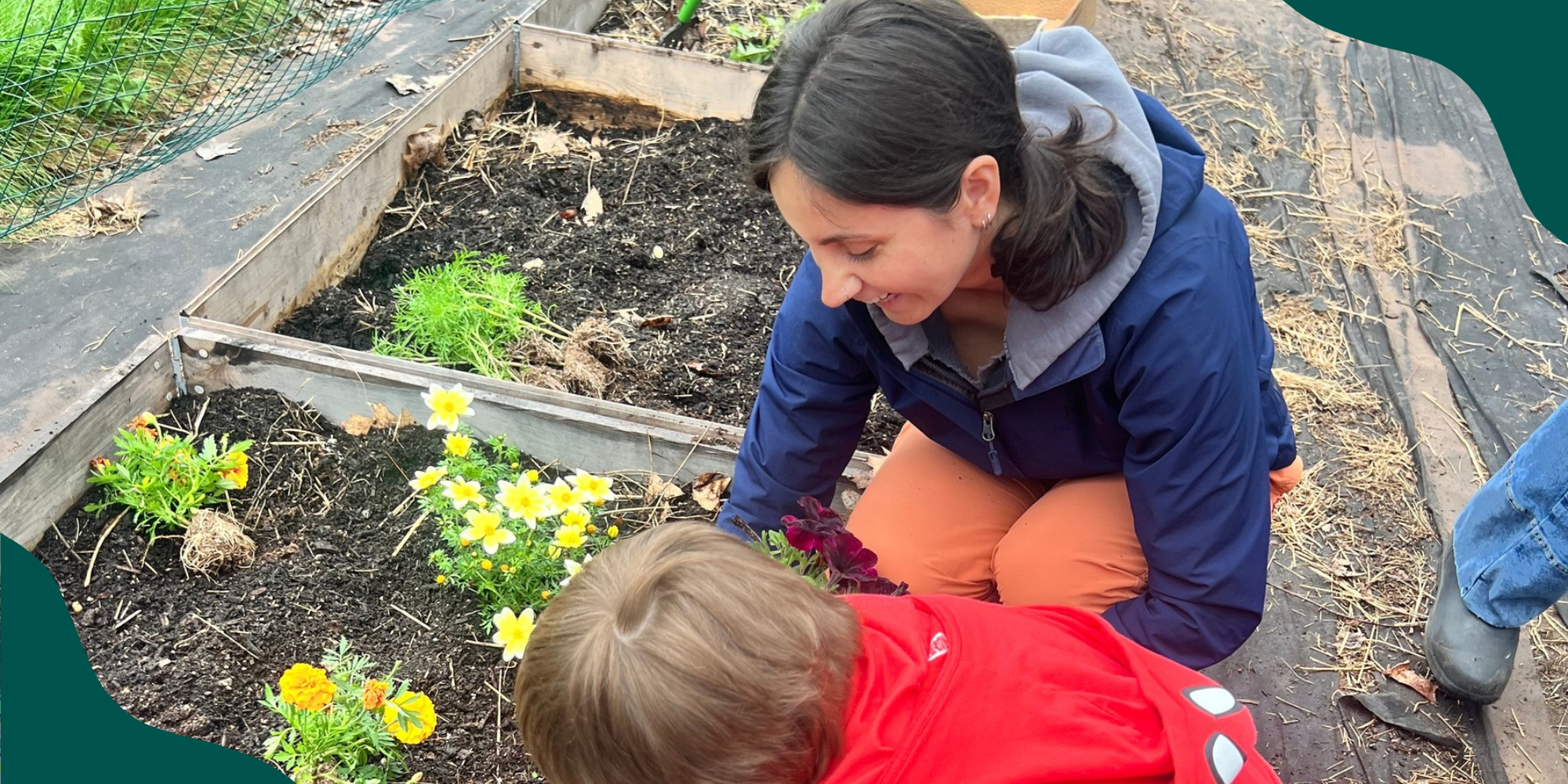
Ruby Forde learned something in a garden long before she knew it would apply to her adult life. As a high schooler in Atlanta, she found her way into an urban agriculture program and discovered that growing food was really about growing community. She fell in love with being outside, with shared work, with what happened when people gathered around something living. That feeling became her compass.
It pointed her to FoodCorps and to rural, western Maine. Today, Ruby is an Outdoor and Experiential Learning Educator for Oxford Hills School District (MSAD17). Her work shifts with the seasons: fall in the gardens harvesting and cooking with kids, winter bringing nutrition and cooking indoors, and spring back in the soil. She came to the district after completing a year of FoodCorps service at Oxford Elementary School. And when the program ended, the district hired her on.
Soon after, she joined our Kindred Fellowship for School Nutrition Leaders’ inaugural class. Built on 15 years of evidence-based, community-centered programming at FoodCorps, the fellowship elevates the work of the country’s school nutrition leaders and brings them together to collaborate and sow seeds of change.
Ruby recently sat down with us to talk about her time as a Kindred Fellow and how it brought her back to her roots.
Ruby: I’d served a year with FoodCorps, so I had some foundation of what FoodCorps programming is all about, but then, transitioning into a more district-led position, I was just feeling a bit of a gap in supervision and support. It can be hard to be the youngest person in the room all the time.
So I was really looking for that support and guidance, and just sharing space with others who are doing the work. It’s really important work, but it can also be really isolating. To be able to break out of that silo and engage with others felt really meaningful.
I don’t know if it’s necessarily a shift in my perspective, but rather a good reminder. I think I’m a pretty action-oriented person, and I think my initial response and reaction is to just jump into a project or a solution. But the biggest thing that I’ve learned throughout this fellowship is that, in order for that change to be really meaningful and sustained, it needs to be more deeply rooted in trust and relationships.
Throughout the Kindred experience, it’s been helpful to pause and take a step back to remember that the time and effort put into relationships and building trust and focusing on strategic thinking and planning, it’s the first and most important thing to do.
I was thinking about this the other day, like, I go out into the garden with the kids, and we’re planting seeds, and I’m telling these children that there’s so much that needs to go into taking care of this seed so that we can produce the food that we want to eat in the fall. It’s not this overnight magic that happens. When I go outside in the garden, I’m not expecting a change to take place immediately. But then I think, sometimes, I have that disconnect between letting that also take place in other change management strategies. You have to put in the real time, effort, and care in order for these things to unfold.
The lessons are sprinkled throughout for sure, but one that really stands out to me was a session on policy and advocacy, and hearing really experienced folks talk about how this one change effort, this one bill, was years in the making. It really helped me imagine what that sustained effort looks like.
I’m designing a pilot compost program at the high school level. Since I work in a rural school district, there are several towns, so each town has one elementary school, but then as students get older, they’re funneled into two different middle schools, and then one high school campus. There’s one high school for the whole district with just over 1,000 students.
The compost project is not off the ground entirely yet, but I’m definitely hoping that it’ll have an impact beyond the school building. The thing that I feel really excited about with this pilot is that the high school itself is located just up the street from the local transfer station, where another community partner has set up a composting station within the transfer station. The dream and the hope is to utilize that space to cart away the food waste from the high school, but then also, as a part of that, the students are interested in designing an educational outreach campaign for the community at large, so that they know how to utilize this resource.
This is also a project that has been bubbling under the surface for several years and came to a head in a really wonderful way. There’s been a lot of interest in the community with specific teachers and departments, but this year, what made it really transformational and lifted it off the ground was student interest and student involvement. There was a group of three or four high school students who came to the Farm to Schools team directly and made this ask for a composting program.
That made all the difference, having those student voices in the room.
It’s a big full-circle moment back to this idea of storytelling and the indescribable feeling [of] when I’m in these really collaborative community spaces. Since I was in high school, that feeling was what got me hooked on wanting to be involved in this sort of work.
My [work] has been a little challenging in terms of logistics and funding and all those sorts of things, so I’ve lost sight of that embodied sense of change-making. But being in the Kindred space and working with the students, I’ve been able to tap back into that. It’s been rekindled in a really positive way.
Ruby’s answers have been lightly edited for length and clarity. Thanks to Janvika Shah for interviewing and writing support.
Hungry for more? Sign up for FoodCorps emails for regular updates about our programming, alumni, and opportunities to make a difference.

New Congress, New Champions, One Shared Commitment to Kids
From the Archive: The Science of Service (2020)
Congress Cut SNAP. States Got the Bill. Kids Face the Consequences.