Food Crops Background
Called to a Life of Nourishment: A Commencement Address
“Food sits at the place where learning and doing meet.” Curt Ellis’s commencement address to the class of 2026.
NEW Food Education in the Classroom Microcredential for K-5 educators! Next session: Nov. 2 – Dec. 13.
“Food sits at the place where learning and doing meet.” Curt Ellis’s commencement address to the class of 2026.
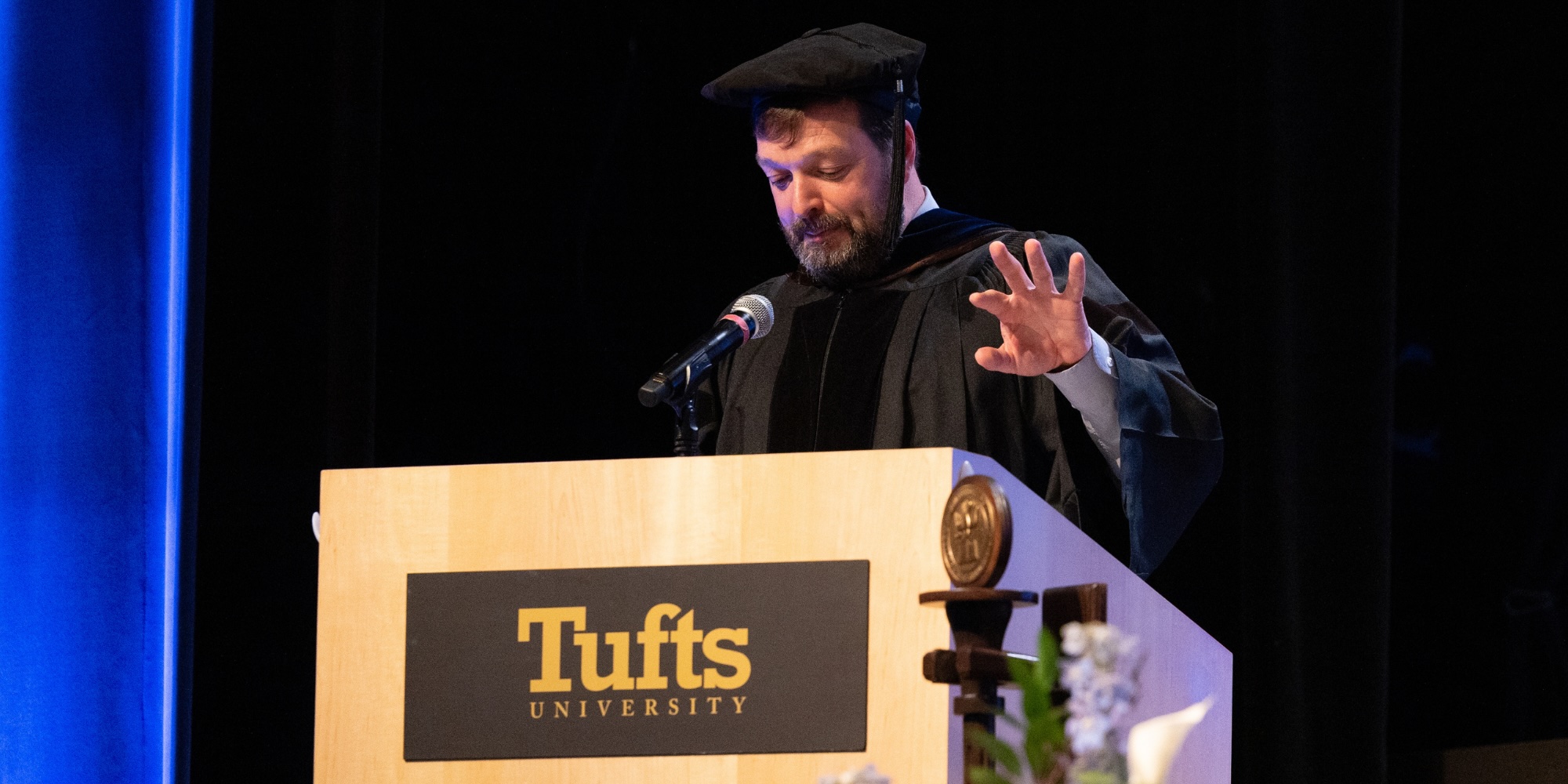
Commencement Address to the Graduates of the The Gerald J. and Dorothy R. Friedman School of Nutrition Science and Policy, Tufts University
May 17, 2026
Curt Ellis, Co-Founder and CEO, FoodCorps
Hello, Friedman School graduates of the class of 2026! Congratulations. It is an honor to share this moment with you, and with so many of your faculty and family and friends. I want to thank Dean Okonomos for the invitation to join you all today.
I also want to thank FoodCorps alumna Sage Loomis for her introduction, and for embodying the humble and authentic approach to leadership that will change our food system for the better. Sage, you bring to life so many of the values I was hoping to talk about today, so more words from me are clearly not needed here.
Actually, I do have a few things I’d like to say to you. But I’ll be honest, it’s intimidating to give advice to a room full of people who have actual expertise—I can tell this because of all the robes—actual expertise in a subject I’ve long claimed to know something about.
I was thinking about what I wanted to say to you a couple of weeks ago as I dug in my garden. I live in Vermont now, at the foot of the Green Mountains. My partner, Emily, and I are raising our four kids there. On this particular Sunday, we were out tending Vermont’s main crop: rocks. We were picking stones and transplanting herbs and chicories that had overwintered, getting ready for spring. I looked down at my hands, and I realized that the only callus I’d built up over the winter was this little spot on my palm where I hold my phone. Anyone else have that one?
Looking at that terribly embarrassing email callus, I realized that what I wanted to talk to you about today wasn’t ideas—the things I type into my phone—but actions. Experiences. Embodiments of food. I realized I wanted to talk to this graduating class, not so much about what I do in my career or at our nonprofit, FoodCorps. But, about why I do it.
After 30 years of finding my way in the field of nutrition, I’ve come to appreciate what I think makes this work special—what, aside from the food puns, keeps me coming back for seconds. It’s this: Food sits at the place where learning and doing meet.
Despite what the new letters after your name might suggest, learning about food and nutrition is far more than an academic project. It’s not work you will complete when you cross this stage today, and receive your prestigious degree from this excellent school. Experiencing food, noticing things in those experiences, and learning from them is something you will do every day, for the rest of your lives.
That’s because, as far back as humanity can trace, food’s truth has been about engaging our whole bodies.
Food is the work of our legs, walking through forests to forage and hunt. Food is the labor of hands, detasseling corn and selecting the strongest plants for seed. Food is the art of mouths, inventing tastes that light up our tongues. And food is the expression of hearts. It connects us to our families, our traditions, our cultures.
In the career you have chosen, you wield the greatest tool our species has ever known for showing connection and care.
My own story of food has been a story of learning by doing, too. It’s a story that begins in a vegetable garden in Oregon, where my favorite childhood memories are of the time I spent at my Dad’s knee there, tending his 50 tomato plants.
I remember, like it was yesterday, a May morning just like this one, even though it was 40 years ago. I was standing next to my Dad, I was holding a hose, counting to ten, feeling the warmth of the sun, and the pride of meaningful work. I was back in that garden a few weeks ago, with my father—now in his mid 80s—and my daughter—now in her mid-eights. We were harvesting the first radishes out of the same childhood garden where I had grown mine.
In that square of dirt, I had learned lessons about patience, about ecology, about family. And now my daughter was learning those lessons, too. Those full-circle moments will come sooner than you think. And often, it will be the smell or taste or touch of food that sparks them. That’s the power of the subject you have chosen to work in.
When I left Oregon and arrived on campus at Yale as a college student, I was troubled by how little attention my classmates and professors paid to food. Amid the Western canon and the computer labs, it was as if we could ignore the fact that all of us depended utterly on this blue-green planet for our survival.
My friend Ian and I wanted to make food and farming more visible on our campus—so we did what any reasonable person would do: we released sheep on the quad. (This act of doing was how we learned that campus police do not know how to stop an activity they had not made a rule against.) Unfortunately for the administration, we didn’t stop there.
We blocked the bluestone paths that students and teachers took to get to class with manure from a local dairy. We took incoming freshmen on orientation trips to local farms, so they arrived on campus more connected to—and covered in—Connecticut’s soil. And we learned—by the hijinks of doing—that we could reconnect our campus to food. We learned that this reconnection felt good to our classmates, too. Good enough that there’s now a farm at the center of the Yale campus—and a far more well-behaved group of students who tend it.
After graduation, I moved to New York City. I was eager for more experiential learning about the food system, so I got a job working on the set of fast-food commercials. The other PA and I rode out to New Jersey in a rented van. We picked up giant boxes of graying taco meat from the prep kitchen of a fast-food chain, and we lugged them back to the studio. There, a team of food stylists picked through the cartons to find the best-looking morsels; the ones they referred to, with a completely straight face, as “the hero meat.”
Delivering a small tray of perfect tacos to the set for a cheese-pull, and lugging the other fifty pounds of meat to the trash, I learned that companies go to great lengths to tell a story about food. A story that might meet truth-in-advertising laws, but isn’t really true. Sometimes, though—you may find this too—a job that isn’t right for you opens the door to one that is.
In my case, I left our “hero” behind, and Ian and I teamed up with a cousin of mine who was a filmmaker. Our goal was to tell a more honest story about America’s food.
We were 22 and needed gas money, so our next chapter of learning-by-doing was driven by necessity. Ian and I re-roofed his parents’ barn in Maine to earn some money, and we found a friend who needed her gold Volvo delivered to Idaho. Then, we set out for a cross-country drive. Our goal was to immerse ourselves in 3,000 miles of America’s food system—to pay attention to how it looked, how it sounded, and how it smelled. On that last point, we were a little too successful.
In Ohio, after waking up by lantern-light one morning at an Amish dairy, we made our way to an industrial egg farm—a cluster of warehouse-looking buildings with nobody around. We stood on the hot pavement for a long time, listening to the cacophony of laying hens confined inside. That day, we learned-by-doing something stupid: we left the car windows down. The Volvo had flies in it all the way to California.
When we reached the west coast, we joined growers on a field tour at a Driscoll strawberry farm. We walked down the plastic-covered rows, as company reps talked up the berry strains they’d selected for longer shelf lives.
In the back room of Berkeley’s Chez Panisse, the restaurant that seeded the farm-to-table movement, we met the chef Alice Waters. Alice fed us berries that wouldn’t last ten minutes on a shelf—mostly because they tasted so good. Our conversation with Alice turned to the Edible Schoolyard she’d started at the nearby Martin Luther King Jr. Middle School, planting seeds that would germinate a few years later, in the form of FoodCorps.
That road trip—those smells and tastes—was our version of research for a film that ultimately included none of those stories: King Corn. We settled on a topic: America’s #1 crop. And we decided to make our documentary in a way where viewers could learn-by-doing alongside us. We moved to Iowa. We planted an acre of corn, and we tended it the same way a farmer might grow a thousand acres.
We injected our field with anhydrous ammonia. And dug up the earthworms killed by the fertilizer. We home-brewed high-fructose corn syrup, using directions from a rather confused brewmaster who answered the phone at one of the big grain companies. And we followed our crop to the local grain elevator, the Chicago Board of Trade, the feedlots of Colorado, and the bodegas of New York City, where doctors told us one in eight residents had diabetes.
Immersing ourselves in America’s industrial food system, we learned how policies set in Washington affected our little acre in Iowa. And how those same policies rippled back to shape the health of consumers far away.
We didn’t expect anyone to watch our polemic about agricultural subsidies when we put it in theaters. But a surprising number of people did. And I think the reason why is that the film’s learning snuck in through the Trojan horse of its doing.
When we took King Corn on a college tour, we met room after room of young people who—like us—wanted to do something to build a more just and healthful and sustainable approach to food. We started to wonder if there could be a way to help those young people see for themselves what was beautiful and broken about the way we farm and eat, and take action to make it better.
That’s why FoodCorps, the nonprofit six of us co-founded, reflects this spirit of learning-by-doing on multiple levels.
The first level is our corps members. Each year, we embed teams of emerging leaders inside school food systems nationwide. They build gardens, test recipes for scratch-cooked school meals, and set up supply chains with local farmers. In the process, they learn first-hand about a school food system seven times the scale of McDonald’s—and what holds it back from its potential.
But the students in FoodCorps schools get to learn by doing, too: they smell the leaves of a tomato plant, they taste a carrot with the dirt still on, they learn fractions by doubling a recipe.
FoodCorps has been doing this work for 15 years now—and as we’ve studied the impact of FoodCorps on public health, we’ve learned that experiential learning is actually the key to its effectiveness. In schools where kids got more hands-on learning about food, they eat triple the fruits and vegetables.
And for our corps members—leaders like Sage—learning by doing has an impact, too. Ninety-one percent of FoodCorps’ 1,800 alumni have gone on to pursue broadly aligned careers, many of them in fields that directly improve access and quality for school meals. More than a third of FoodCorps alumni have stepped into community leadership roles on boards or councils where they continue to make a difference.
Learning-by-doing, it turns out, is a cycle that builds power. Doing builds learning, learning builds leadership, leadership builds change. The reason I am so excited for you today—and so grateful for you—is that when you cross this stage, you will propel the movement for a more just and healthful and sustainable food system into another spin of that cycle.
I will leave you with this: the diploma you collect today will say “nutrition.” But you are being called to a life of nourishment. A life where you will keep learning by doing every day. A life rooted in the fact that we can uncover extraordinary truths about food with our minds—but to honor the power of food, we must stay grounded in the knowledge that food is also the work of our hands, and the work of our heart.
So, whether you have studied agriculture and the environment here, or molecular nutrition, or data analytics and AI, in all of these fields of study, you have been prepared for a life of work that is not just cerebral; it is fundamental.
You leave here ready to write the next chapter of what I believe is humanity’s most meaningful work: coaxing seeds out of soil, preparing meals that feed our bodies and convey our cultures, finding ways to show other humans how much we care.
Congratulations on taking this next step into lives of beautiful and active work.
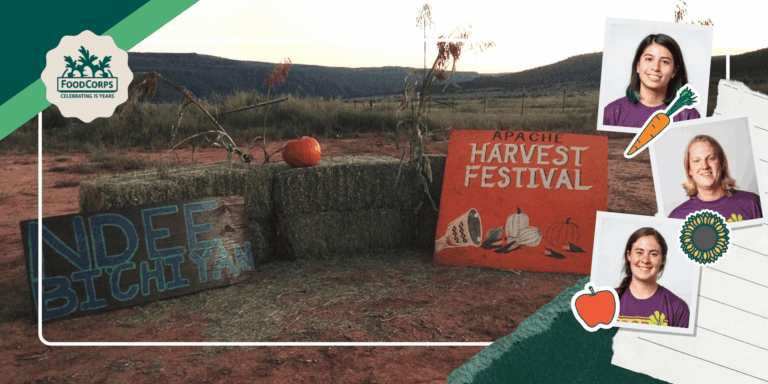
From the Archive: Farm to School in Native Communities (2015)
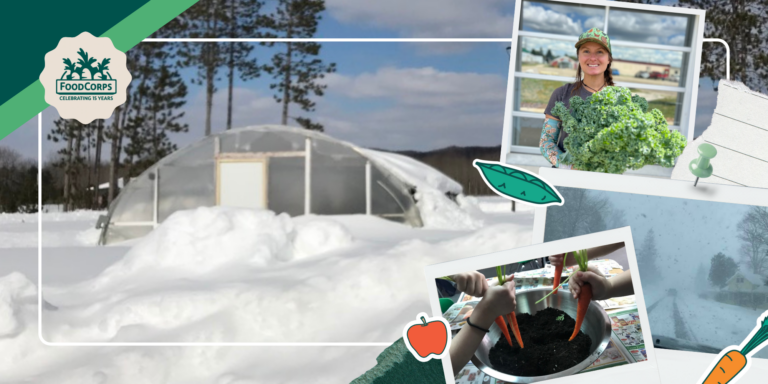
From the Archive: Snow Days, Hungry Days (2019)
Policy Spotlight: 15 Years That Shaped School Meals