Food Crops Background
Policy Spotlight: 15 Years That Shaped School Meals
15 years of progress, challenges, and advocacy in school food policy.
NEW Food Education in the Classroom Microcredential for K-5 educators! Next session: Nov. 2 – Dec. 13.
15 years of progress, challenges, and advocacy in school food policy.
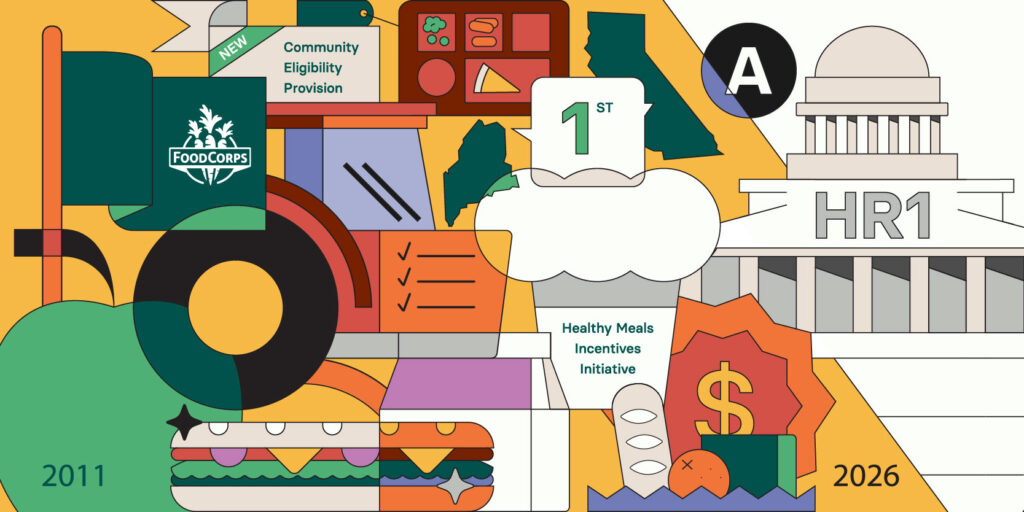
When FoodCorps launched in 2011, school food was entering a new era.
The Healthy, Hunger-Free Kids Act had just become law, setting in motion stronger nutrition standards for school meals. In the years that followed, policy changes expanded access to free meals, strengthened connections between schools and local food producers, and supported healthier food in cafeterias across the country.
But change hasn’t always moved in the same direction. While some policies expanded access and strengthened school meals, others have rolled back progress or threatened to put gains at risk.
FoodCorps has grown alongside these shifts, from an AmeriCorps-powered effort rooted in food education and school gardens to work spanning school meals, local food systems, leadership development, and policy and advocacy. Here are some of the moments that shaped school food along the way.
FoodCorps began service in 2011, just as schools were beginning to implement the Healthy, Hunger-Free Kids Act. New federal nutrition standards followed in 2012, requiring more fruits, vegetables, and whole grains in school meals and setting stronger limits on sodium and other nutrients.
The USDA Farm to School Grant Program strengthened connections between schools and local producers, Smart Snacks established nutrition standards for foods sold elsewhere in schools, and states expanded school breakfast through Breakfast After the Bell policies.
In 2014, the Community Eligibility Provision, or CEP, became available nationwide, allowing eligible schools to provide free breakfast and lunch to every student without requiring families to complete individual meal applications.
For FoodCorps, these early years reinforced a belief that still guides our work today: nourishing school meals require both nutritious food and meaningful access. What’s on the tray matters just as much as where it comes from and whether students can eat without stigma or unnecessary barriers.
By the middle of the decade, school food policy was expanding beyond meal standards alone. In 2015, USDA established new professional standards for school nutrition professionals. In 2016, USDA updated nutrition standards for the Child and Adult Care Food Program, strengthening meals served in child care and afterschool settings.
Some earlier gains also came under pressure. In 2018, USDA weakened portions of the Healthy, Hunger-Free Kids Act standards for whole grains, sodium, and flavored milk, changes that FoodCorps and other child nutrition advocates opposed.
That same year, the Farm Bill continued federal support for Farm to School and included provisions to strengthen local and regional food systems.
When the COVID-19 pandemic closed school buildings in spring 2020, school nutrition professionals had to reinvent meal service almost overnight. Federal waivers enabled curbside pickup, bus-route distribution, and other flexible models, while Pandemic EBT helped families replace meals missed at school. Food insecurity among households with children also rose, interrupting nearly a decade of decline.
In response, federal waivers allowed schools across the country to serve students meals at no cost to families. The pandemic exposed the fragility of the school food system, but it also showed how quickly policy could remove barriers when policymakers chose to act.
In 2021, California and Maine became the first states to make free school meals for all students permanent, helping launch a broader School Meals for All movement.
Federal universal meals ended in 2022, but other pandemic-era changes became lasting policy. Congress permanently authorized Summer EBT, now known as SUN Bucks, and non-congregate summer meals in eligible rural communities. USDA also launched major investments in local food purchasing and healthier school meals, including the Local Food for Schools program and Healthy Meals Incentives Initiative.
In 2023, Colorado, Minnesota, Michigan, Massachusetts, New Mexico, and Vermont enacted or implemented statewide School Meals for All policies. New York followed in 2025. FoodCorps has supported this growing momentum through state advocacy and, in 2024, launched our School Food Policy Action Map to help people understand what’s happening in their own states and find opportunities to take action.
Federal policy continued to reshape school food. USDA made more schools eligible for the Community Eligibility Provision in 2023, Summer EBT launched nationwide in 2024, and USDA finalized updated school nutrition standards.
By 2025, however, several federal actions moved in the opposite direction. USDA terminated planned Local Food for Schools and Child Care funding; AmeriCorps faced major disruption affecting national service programs, including FoodCorps; and Congress enacted H.R. 1, making sweeping changes to SNAP with implications for direct certification, CEP participation, and school meal access. USDA also announced it would end its longstanding annual Household Food Security Report, removing a key tool for understanding the scale of hunger and food insecurity nationwide.
In 2026, implementation of those SNAP changes continued, while USDA and HHS released new Dietary Guidelines for Americans.
The past 15 years have shown what policy can make possible, from healthier meals and stronger local food systems to fewer barriers between students and the food they need. They have also shown that progress is not guaranteed.
That is why advocacy remains central to FoodCorps’ work. We will keep pushing for free school meals for all students, strong school kitchens, locally sourced and scratch-cooked food, hands-on food education, well-supported school nutrition professionals, and federal nutrition programs that help every child thrive. In the years ahead, we’ll keep building on what works, protecting the progress we’ve made, and pushing toward what kids deserve. We’re glad to have you with us for what comes next.
Want more school food policy news? Sign up for our emails.
From the Archive: Farm to School in Native Communities (2015)

From the Archive: Snow Days, Hungry Days (2019)
Lunch Today, Leaders Tomorrow: 15 Years of FoodCorps