Food Crops Background
How Are School Meals Funded?
A complex process with a simple bottom line: well-fed kids who are ready to learn.
NEW Food Education in the Classroom Microcredential for K-5 educators! Next session: Nov. 2 – Dec. 13.
A complex process with a simple bottom line: well-fed kids who are ready to learn.

It’s easy to take for granted the fact that U.S. public schools are set up to feed millions of kids school meals every day. Many of us can picture the kids in our lives—or remember from our own childhood—getting into the lunch line, choosing from a variety of foods, and sitting down to eat with friends, a welcome break from textbooks and tests.
What may be less clear is how those meals are funded. Who decides how much families pay? How does the government play a role? What allows some schools to feed every student for free? And why are more communities getting on board with making school meals free for all kids?
Here, we dive into the dollar signs behind school meals.
School nutrition programs have budgets separate from education spending, with funds coming almost entirely from the federal government rather than local taxes. That means school meals never compete with teacher salaries or school supplies for funding. That’s also why school food funds aren’t impacted by local economic downturns that can strain education budgets.
The federal funds for school meals are permanently authorized thanks to the National School Lunch Act of 1946 and the Child Nutrition Act of 1966, meaning these funds are protected from federal budget fluctuations (and government shutdowns). They also flex with demand: the more kids a school feeds, the more funding it receives.
Each year, Congress decides how much to allocate for school meals based on projections from the U.S. Department of Agriculture, which oversees the National School Lunch Program and School Breakfast Program. USDA forecasts school meal participation and costs, and adjusts per-meal reimbursement rates based on inflation. Congress then sends funds to USDA, which passes them on to state agencies, which doles out funds to school nutrition departments. This pool of money has plenty of baked-in flexibility, making it possible to cover costs when demand is higher than expected and allowing schools to roll over any unused funds to the next year.
Because federal funds for school meals come as reimbursements, school nutrition departments have to pay upfront to prepare and serve the meals. They track actual participation by category—free, reduced-cost, and full-price meals, which are determined by family income. Schools report those amounts to their relevant state agency, which draws from the USDA-provided funds to pay back the school nutrition department based on federal reimbursement rates.
Every meal served gets a reimbursement, with higher amounts for free and lower-cost meals. While each school nutrition department decides its own meal pricing (following USDA-set requirements), even families paying “full” price are likely saving money: a school-provided lunch (averaging $3 in 2025–26) can cost half as much as bringing one from home.
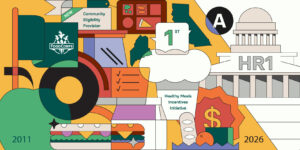
The Healthy, Hunger-Free Kids Act of 2010 was arguably the most significant update to school meals since the birth of the modern federal breakfast and lunch programs. One reason: the Community Eligibility Provision.
The Community Eligibility Provision, or CEP, allows schools to provide every student with breakfast and lunch without requiring households to submit school meal applications. Schools are eligible when 25% of students qualify to receive free school meals, based on participation in federal benefits programs like SNAP. Schools can be eligible individually, or districts can group schools to expand access to a broader population of students, as long as they meet the 25% threshold.
CEP has been a huge success. Participation has grown steadily over the past decade that the program has been available, feeding millions of students today. Its popularity—and many benefits—has built momentum around making school meals free for all students nationwide.
The laws that created our modern school meal programs were put in place to improve child nutrition. Eighty years after the launch of the National School Lunch Program, it’s still doing just that, benefiting some 30 million students a year. But the system is straining, with a growing number of school nutrition programs struggling to cover the costs of school meals. In the 2024–25 school year, 67% of school nutrition directors said the current reimbursement rates were not enough to cover the costs of producing a lunch.
This financial pressure is driving a broader push for free healthy school meals for all students. Today, nine states have made school meals free for all public school students. And at least 28 others have introduced free school meal policies. States with these laws are still using the federal reimbursement system while covering the gap that federal funds don’t cover. But that means these state-level policies face the same annual budget pressures as other state expenses.
Advocates are pushing for a nationwide solution. Most recently, in May 2026, Senator Bernie Sanders (I-VT) and Representative Ilhan Omar (D-MN) reintroduced the Universal School Meals Program Act. The bill would provide free breakfast, lunch, dinner, and a snack to every student nationwide, while eliminating school lunch debt and increasing reimbursement rates alongside other provisions to support school meal programs that benefit kids.
Follow the money: Want to stay in the know about school meal funding and efforts to help schools feed more kids healthy meals? Create an Advocacy Profile to get notifications about when and how to voice your support.

From the Archive: Farm to School in Native Communities (2015)

From the Archive: Snow Days, Hungry Days (2019)
Policy Spotlight: 15 Years That Shaped School Meals